Overview
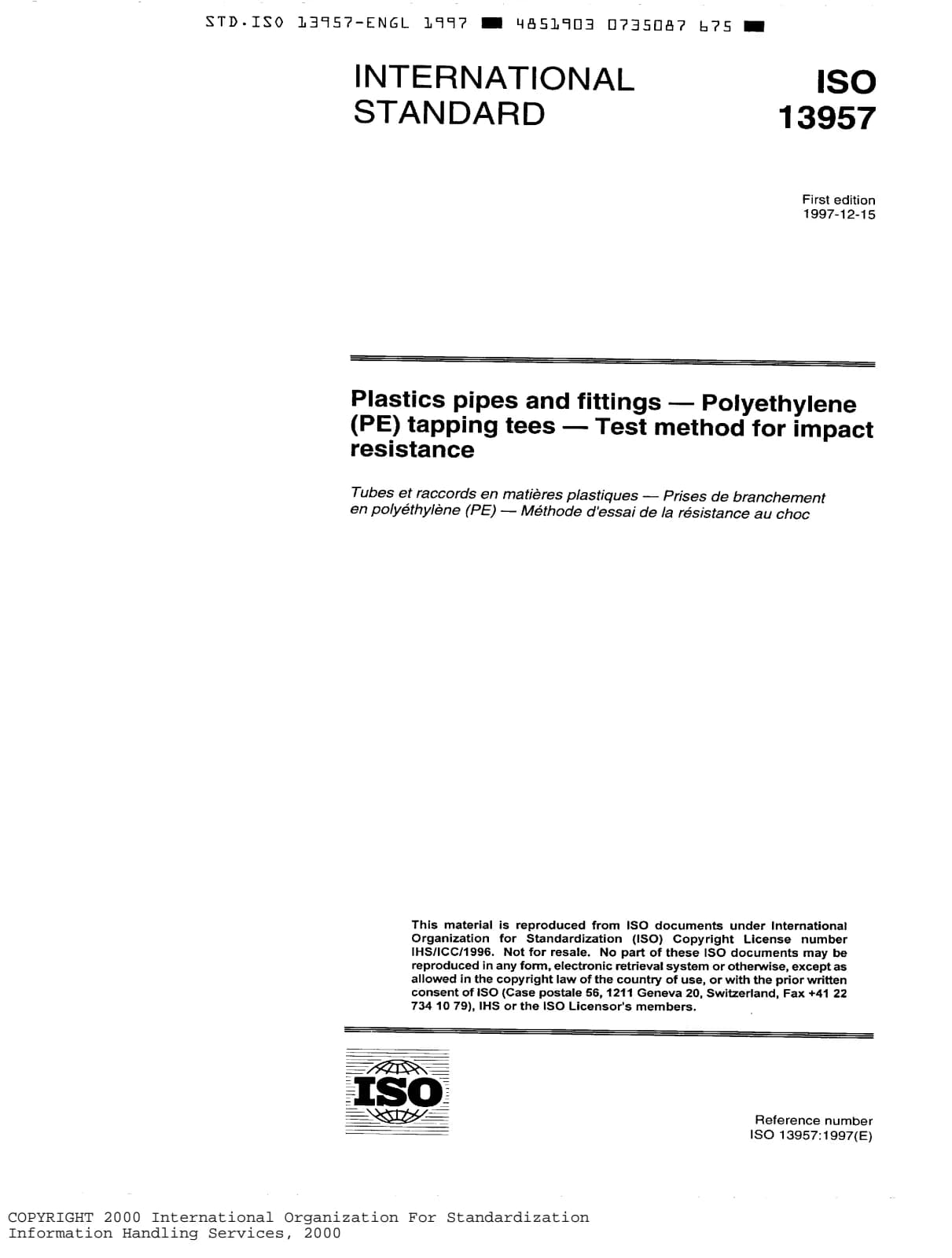
ISO 13957:1997 specifies a standardized test method for impact resistance of polyethylene (PE) tapping tees used in plastic pipes and fittings for fluid conveyance. The standard describes the apparatus, conditioning, test procedure and acceptance checks to determine whether a PE tapping tee withstands impact without visible damage or loss of airtightness.
Key Topics and Requirements
- Scope: Impact-resistance testing of PE tapping tees intended for fluid conveyance.
- Test principle: A striker weight is dropped vertically onto the cap or branch top of a tapping tee fused to a pipe; two impacts are applied from opposite directions, then the joint is inspected for cracks and airtightness loss.
- Apparatus
- Falling-weight machine with guide ensuring striker velocity ≥ 95% of theoretical.
- Striker mass: 2 500 g ± 20 g or 5 000 g ± 20 g with a 50 mm hemispherical striking surface.
- Rigid test holder with steel mandrel to prevent rotation.
- Test pieces and assembly
- Minimum three test pieces per tapping tee size.
- Complete pipe/tapping tee assemblies fused according to manufacturer instructions or relevant standards.
- Pre-test airtightness check at 25 mbar or 6 bar at 23 °C ± 2 °C.
- Conditioning
- Wait at least 8 hours after fusion, then condition at 0 °C ± 2 °C for 4 h (air) or 2 h (liquid bath).
- Procedure
- Drop height: 2 000 mm ± 10 mm along axis parallel to pipe.
- Point of impact: within 30 mm of the branch top, preferably on a cylindrical cap section.
- After two opposite impacts, visually inspect (no magnification) for cracks/ruptures and verify airtightness at 23 °C ± 2 °C using internal pressure 25 mbar or 6 bar.
- Test report must include reference to , sample identification, test temperature, striker mass, drop height, number of pieces, failure types, observations, test date and laboratory.

 Открыть превью (PDF)Plastics pipes and fittings — Polyethylene (PE) tapping tees — Test method for impact resistance